
The flow of information is a good starting point for a little investigation of how the essential inputs to our society – to our technological world, to our economy – have shaped and will keep shaping our ability to innovate. Our ways of handling information, generating it, storing it, granting or denying access to it, transmitting and sharing … Continue reading How information flow empowers innovation – Part 1
Tag: literacy
It’s about time …
Time turns out to be a difficult subject to handle, especially when we are trying to make sense of what is lying ahead, when we are talking and thinking about the future. We often feel a sense of puzzle and confusion, an uncomfortable element of surprise. In Alvin Toffler's famous words: "The future always comes too fast and in the wrong order."
Integrating citizen science
The concept has many names: networked science, crowd-sourced science, crowd science, civic science, or citizen science. All these terms emphasise a specific aspect, and all those aspects play a more or less important role in the overall concept. Let's see.
Funding innovation – a broken cycle?

Without a doubt, Clayton Christensen is one of the most prolific thinkers, scholars, and writers on innovation. He is probably best known for having coined the term “disruptive innovation”, but that is only the tip of the iceberg. He developed a theory of economic growth that builds on three types of innovation: disruptive, sustaining, and efficiency innovations. Let’s see.
On literacy
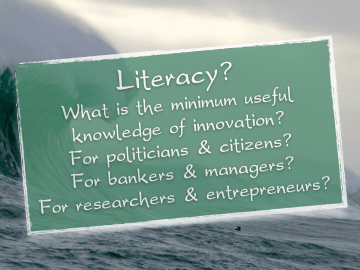
Previously, I’ve discussed some flaws in the way that we teach science, and the particular implications for scientists themselves. However, the view(s) that non-scientists hold of science influence the success or failure of science in a multitude of ways, even though they are not active practitioners. How then does basic science education shape the views of the non-scientists?
 understanding innovation