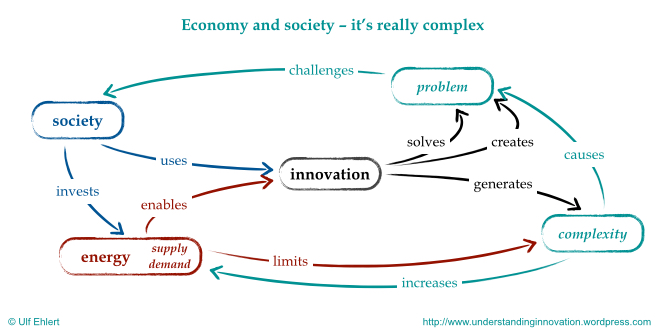
Recently I've presented some ideas on the complex interrelation between energy, society, and innovation. As you might have expected, the textual description of that topic is complex as well; hence I've worked on some simple charts to support the overall storyline. A first simple overview could look like two cycles connected through innovation. On the left, you'll find … Continue reading Energy and society – some simple charts …
Tag: limits
Why innovation policy must be innovative
About a year ago I came across the work of the historian and archaeologist Ian Morris, who observed that "change is caused by lazy, greedy, frightened people looking for easier, more profitable, and safer ways of doing things". This Morris Theorem essentially presents human sloth, greed, and fear as the key drivers for our society's appetite for change – change of our environment to our own benefit. That is what we call innovation: the purpose is an easier, richer, safer life for all of us.
Pushing the boundaries – Epilogue
Over the past few weeks I've visited the four quadrants of the innovation landscape (the short series of posts started here) to get a better idea of the boundaries between the quadrants and how they are pushed. Now it's time to zoom out again to take a look at the landscape as a whole, with two questions to consider: Is the landscape as symmetric as it seems? And how fast do the boundaries move?
The bounds of the wicked quadrant …
The wicked quadrant of the innovation landscape is characterised by deep uncertainty: nothing is known, nothing is established, neither rules nor tools are defined or available. That makes this fourth quadrant the antithesis of the certainty that shapes business as usual; but what does that mean for innovation in the fourth quadrant? Let's step a little closer.
Pushing the boundaries – Prologue
There are two distinct boundaries in the innovation landscape. One boundary separates the known ideas from novel ideas. The other boundary divides the landscape into the areas of known problems on one side and unknown or unacknowledged problems on the other. Both are boundaries between the unknown and the unknown, hence these boundaries will be pushed forward everytime of novel idea is developed or a new problem is encountered.


