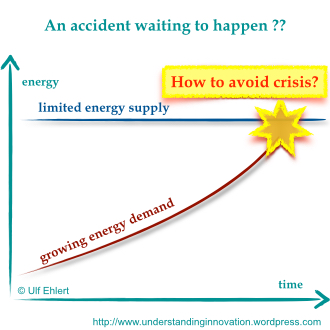
Energy, society, complexity and innovation are intertwined through a multitude of interrelations that are sometimes difficult to grasp. In an earlier post, I've offered a storyline to describe this nexus, based on the considerations of Joseph Tainter and Ian Morris. In essence, the energy supply available to a society poses a limit on the complexity this society can … Continue reading Energy and society – an accident waiting to happen?
Tag: constraints
Energy and society – some simple charts …
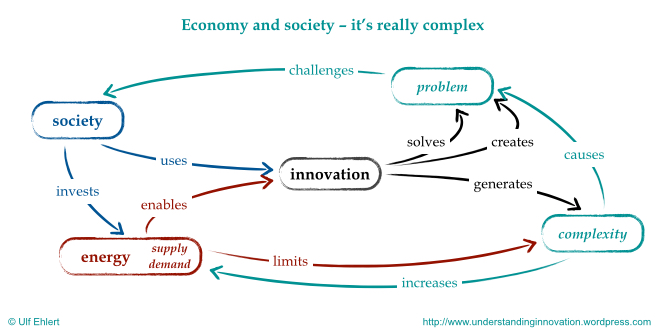
Recently I've presented some ideas on the complex interrelation between energy, society, and innovation. As you might have expected, the textual description of that topic is complex as well; hence I've worked on some simple charts to support the overall storyline. A first simple overview could look like two cycles connected through innovation. On the left, you'll find … Continue reading Energy and society – some simple charts …
Who bears the risk of innovation failure?
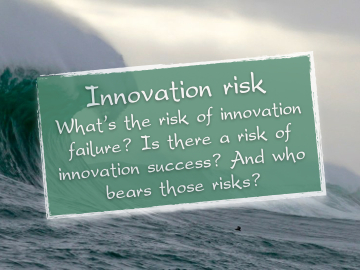
Innovation is all about novelty, about charting new territory and sailing unknown waters. This implies that the outcome of any innovative endeavour is by no means certain, let alone predetermined. On the contrary, innovation clearly entails risk, and in fact two different types of risk: one is for the innovator, the other for the society he's working in. With only mild exaggeration, you might consider the first the risk of innovation failure, whereas the other is the risk of innovation success.
It’s about time …
Time turns out to be a difficult subject to handle, especially when we are trying to make sense of what is lying ahead, when we are talking and thinking about the future. We often feel a sense of puzzle and confusion, an uncomfortable element of surprise. In Alvin Toffler's famous words: "The future always comes too fast and in the wrong order."
Integrating citizen science
The concept has many names: networked science, crowd-sourced science, crowd science, civic science, or citizen science. All these terms emphasise a specific aspect, and all those aspects play a more or less important role in the overall concept. Let's see.