Over the last century, Big Business transformed dramatically, several times. What used to be in the hands of heavy industry, of oil and steel, gradually became the domain of the chemical, pharmaceutical, automotive and later on consumer electronics industries. And from the 1990s onwards, it morphed again as the Digital Revolution unfolded. Today, Big Business … Continue reading Disrupting Big Business
Tag: speed
Why we need to broaden our innovation mindset
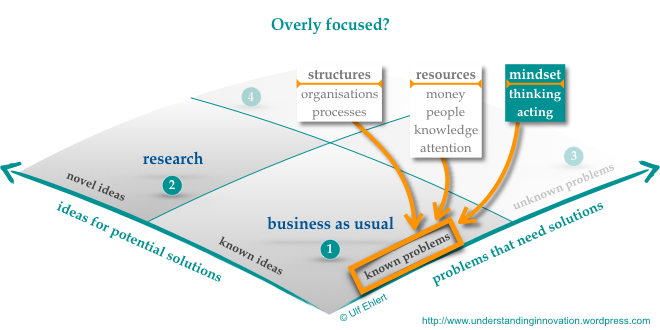
You might picture our established structures as the hardware that we run our innovation supply chain on. They certainly direct the energy, the resources we invest in innovation. And they have significant implications for our "innovation software", i.e., our understanding of innovation, our innovation mindset. That's what I'll discuss today along two main questions: the first deals with … Continue reading Why we need to broaden our innovation mindset
Different scales, different purposes, all intertwined
Complex adaptive systems exists at different scales, both spatial and temporal. As Lance Gunderson and Crawford Holling described it, those different scales form of structure of nested adaptive cycles. To make this idea a bit more tangible, let's take weather and climate: we are all exposed to the very local patterns every minute we are outdoors; we take into … Continue reading Different scales, different purposes, all intertwined
Adaptive cycles and innovation – first contact
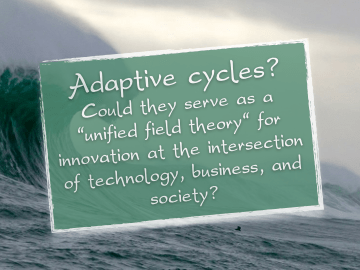
What is it that adaptive cycles could tell us about innovation? Which new perspective could they give us? Could they actually serve as a common backdrop, a "unifying field theory" that covers all dimensions of innovation? That could incorporate the relevant aspects of technology, business, and society? I'm curious to learn more about the ups and … Continue reading Adaptive cycles and innovation – first contact
The Dunning-Kruger effect in innovation
One way or another, I'm sure you are all familiar with the Dunning-Kruger effect. You might have heard about it under the label of confident idiots, describing a behaviour of an unskilled individual being unaware of the lack of a specific skill, instead assuming to have a skill-level that is even superior to the experts in the field. … Continue reading The Dunning-Kruger effect in innovation