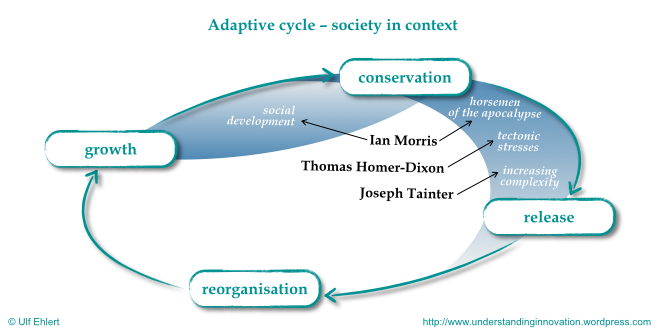
Innovation landscape & adaptive cycles – Part 2

In the previous post I've investigated the relation between two of the major concepts that I had discussed earlier: the innovation landscape on one hand and the adaptive cycles on the other. I focused on the part of the innovation landscape that is defined by known problems, i.e., the business as usual quadrant and the research quadrant. Together, with some overlap, those … Continue reading Innovation landscape & adaptive cycles – Part 2
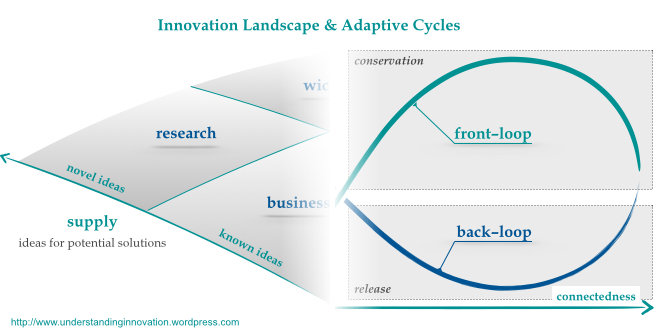
Innovation landscape & adaptive cycles – Part 1

Over the course of this blogging journey, I explored several conceptual ideas that have started to frame my own understanding of innovation, what it is and how it works. The first of those major concepts is the innovation landscape (see initial introduction here, overview of previous posts here) that spans between the demand for innovation (the problems that need to … Continue reading Innovation landscape & adaptive cycles – Part 1

Opposing objectives

The front–loop of the adaptive cycle is very present in our daily experience, no wonder that it dominates our thinking as well. It's the place where we are most comfortable, where we want to be. Continued growth and the accumulation of resources create an impression that all change is positive, that all change is progress: your business model is … Continue reading Opposing objectives

Some second thoughts on first contact

The concept of adaptive cycles can serve as a framework for a rich discussion on innovation. However, before diving deeper into the specifics of the concept, let's look at the basic description of the adaptive cycles again and review some of the earlier posts on this blog: to what extent do those ideas fit with this concept? I'd … Continue reading Some second thoughts on first contact

The dynamic ups and downs of human systems

No matter how hard we try to keep things simple and under control, many man-made systems turn out to be – or to become over time – quite complex and unpredictable. Despite our effort. Against our intentions. In stark contrast to our preference for simple, linear, static, controllable, predictable systems. Computer software, stock markets and tax codes are … Continue reading The dynamic ups and downs of human systems