How we will work in the future? And how much? These questions do not only address the work of the future; more importantly, they imply an underlying fundamental question: What is the future of work? Conventional wisdom would reply that we'll all work differently than today, and a probably little less; but overall everybody will … Continue reading Disrupting economics
Tag: rules of the game
Disrupting politics
When you look at the detailed results of a couple of recent elections or referenda, you’ll find clear symptoms for a serious divide between voters in cities and voters in rural areas. Just take the following three examples, which all occurred over the last twelve months: the Brexit referendum in the United Kingdom in June … Continue reading Disrupting politics
Innovation landscape & adaptive cycles – Part 2
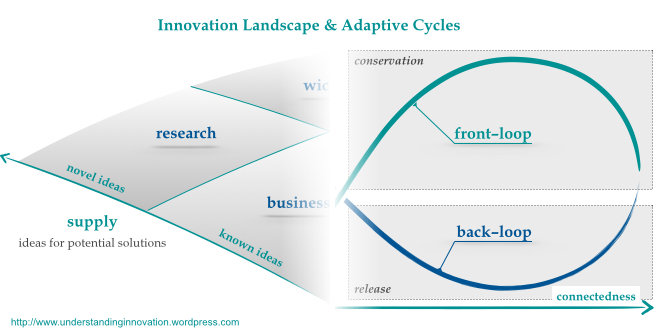
In the previous post I've investigated the relation between two of the major concepts that I had discussed earlier: the innovation landscape on one hand and the adaptive cycles on the other. I focused on the part of the innovation landscape that is defined by known problems, i.e., the business as usual quadrant and the research quadrant. Together, with some overlap, those … Continue reading Innovation landscape & adaptive cycles – Part 2
Innovation landscape & adaptive cycles – Part 1
Over the course of this blogging journey, I explored several conceptual ideas that have started to frame my own understanding of innovation, what it is and how it works. The first of those major concepts is the innovation landscape (see initial introduction here, overview of previous posts here) that spans between the demand for innovation (the problems that need to … Continue reading Innovation landscape & adaptive cycles – Part 1
The bounds of the wicked quadrant …
The wicked quadrant of the innovation landscape is characterised by deep uncertainty: nothing is known, nothing is established, neither rules nor tools are defined or available. That makes this fourth quadrant the antithesis of the certainty that shapes business as usual; but what does that mean for innovation in the fourth quadrant? Let's step a little closer.