
Innovators are agents of change. They pursue novelty, often in the face of adversity. To succeed, they need to consider the other agents they are surrounded by. And they must embrace their own agency in all its facets in order to maximise the impact they have.
Tag: resistance
Formatting our world

The language we speak, the organisation we live or work in, and the technology we use all have one thing in common: they format our world. They shape how we think about it, how we see it, how we behave in it, and how we interact with it. All that formatting has tremendous advantages in our day-to-day lives. Yet it also provides an explanation for the challenges innovators face when they develop something novel that does not fit any of the pre-established formats.
How to have more insights
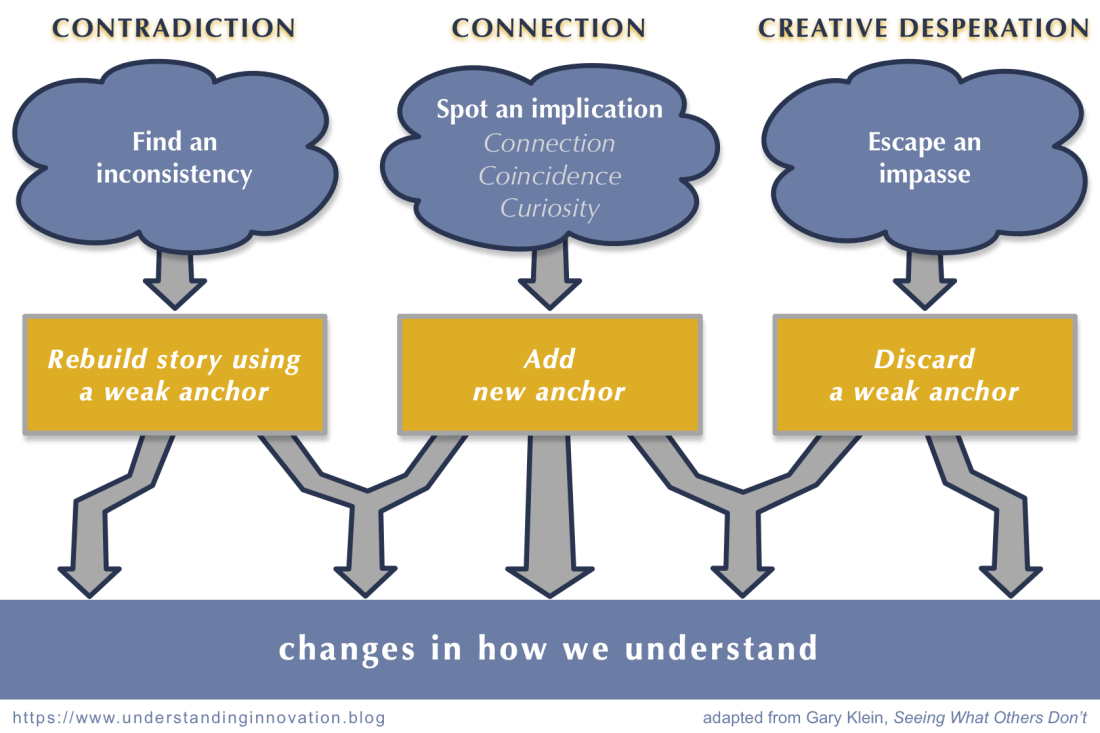
The cognitive psychologist Gary Klein proposed the triple path model to explain how we have insights. Furthermore, Klein systematically searched for hindrances and encouragements to having insight. It should be interesting to compare his findings with Steven Johnson's analysis of the conditions that make good ideas flourish. Good ideas need insights, and conditions for the success of one should promote the other. Let's find out.
Innovation is a hostile act
For many good reasons, innovation is widely appreciated as a positive force, as the driver for progress and prosperity. But make no mistake: innovation has serious downsides, at least for some, at least sometimes. Even though these negative impacts are far outweighed by the positive effects, they are the source of considerable push-back and utter resistance to innovation. And it would be too easy to dismiss justified concerns as irrational, dump, backwards-oriented, or fear-mongering. It's time to cast some light on the hostility even the best intended innovator might be faced with. It's time to acknowledge that innovation itself is a hostile act. Here's why.
The entrepreneurial mind

When you are asked to describe the essence of an innovative mind-set, you are faced with a dilemma, as expectations are high and preconceived ideas differ widely. The question you receive is often one for concrete advice: Which values should an organisation embrace to implement an innovation culture? How can an individual be more innovative? But … Continue reading The entrepreneurial mind
 understanding innovation