
Let's turn to the agent’s inner workings: What happens between those inputs and outputs? This requires some information processing, so that the agent compares the outside world with the agent’s purpose, and then discerns —from that comparison— an appropriate response.
Tag: resilience
Socio-technical systems as artificial agents
This third group of artificial agents sits somewhere between organization and technology, as a blend of both. To understand the agency of socio-technical systems, it is helpful to remember that they belong to the complex adaptive systems. They are open, dynamic, and nonlinear; and they exhibit emergence and resilience.
Embrace the seeming paradox!
Let's face it: your problems are like spoiled brats, just too willing to misbehave. And they can easily afford to be ill-tempered, irrational, incoherent, inconsistent. However, you cannot. Not as an individual, not as a leader, not as an organisation. For you must uphold some level of coherence and consistency to maintain your credibility (and I would add: your self-esteem). How can you achieve that goal if your problems obviously don't play fair?
Reading the map – East or West?
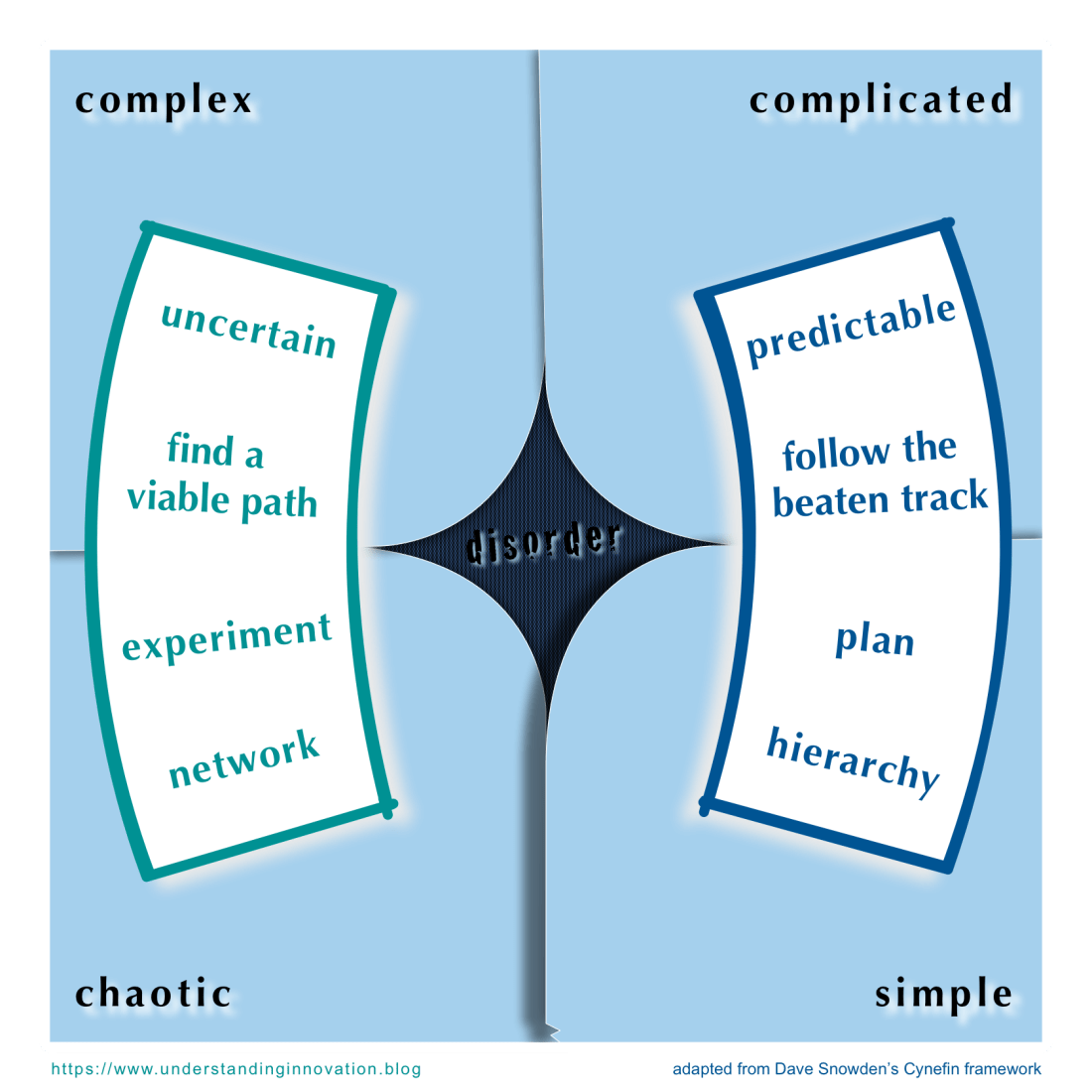
The Cynefin framework is a sense-making model that can serve as a map to give you some orientation in challenging situations of decision-making or problem-solving. Recently, I took a closer look at how you could read this map and why it is prudent to avoid the Southern domains. Today, I'll investigate the main differences between the Eastern and the Western domains and how those will affect your chances of success.
Reading the map – Keep to the North!
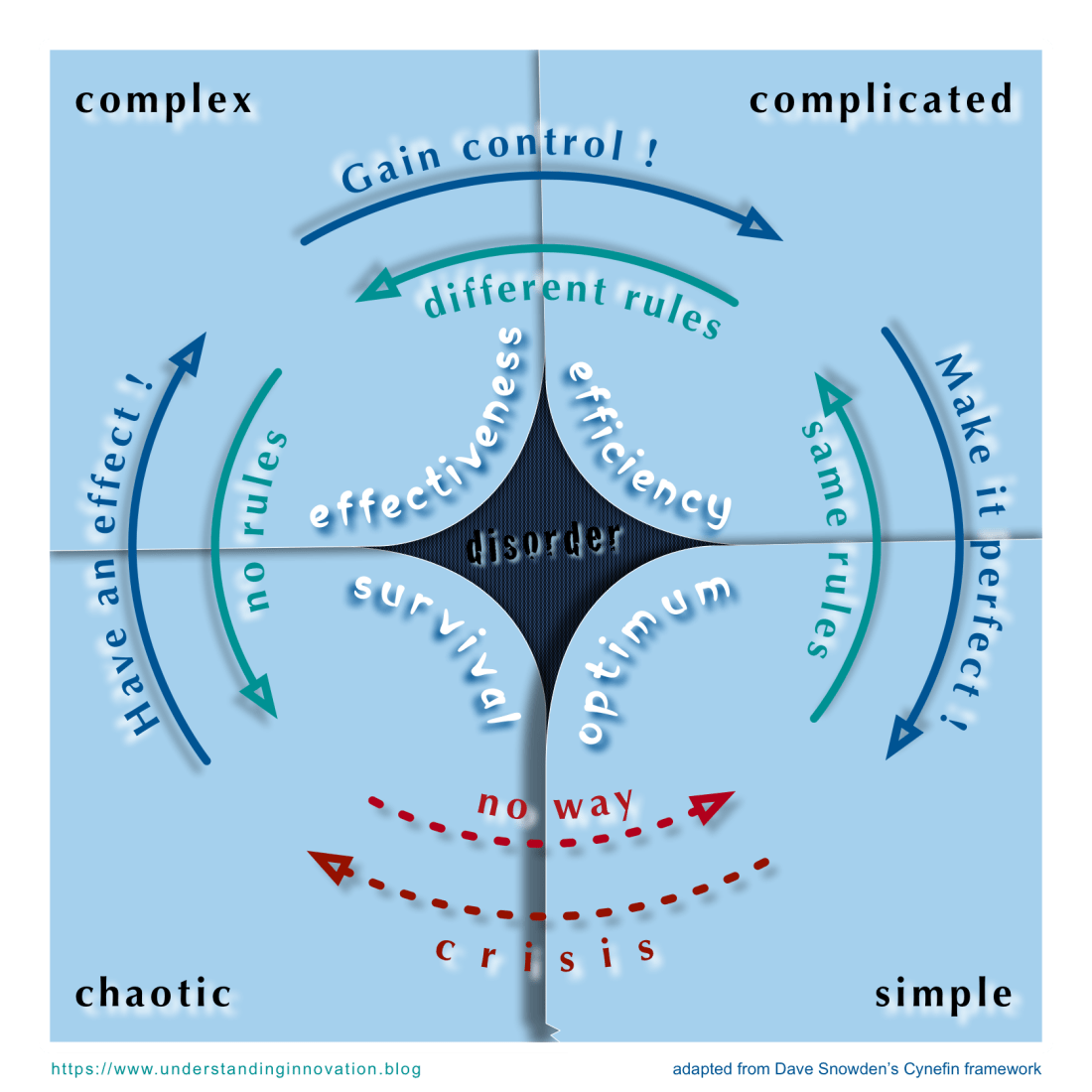
Over the past few weeks, I introduced you to a sense-making model developed by Dave Snowden. His Cynefin framework can serve as a map to give you some orientation in challenging situations of decision-making or problem-solving. Today, let's take a closer look at how you can read this map, and why it's advisable to avoid the South.
 understanding innovation