What could our economy and society be like in thirty to forty, maybe even fifty years? Just doing the same things differently? Or doing really different things? What could those things be? And what could economics tell us about that far-term future? If you ask for such genuine vision, the reaction you'll most likely receive ranges somewhere between an innocent shrug and a linear extrapolation of the recent past: neither inspired nor very inspiring. With only few exceptions.
Tag: purpose
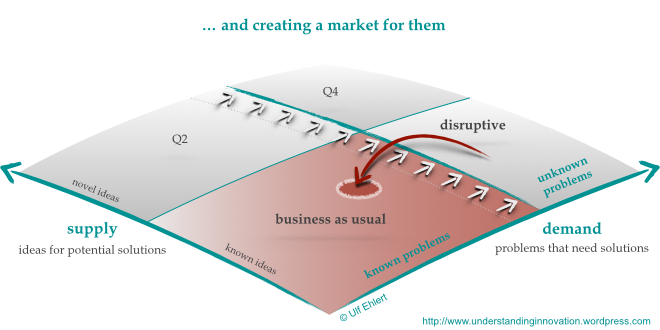
How disruption pushes the boundary …
The innovation landscape I have sketched previously suggests that there could be some kind of symmetry. The third quadrant (disruptive) should have some similarity with the second quadrant (research), shouldn't it?
Innovation & Science
Intuitively we know that science is somehow related to innovation. It is somewhere at the origin of innovation, isn’t it? Science underpins innovation, doesn’t it? But this relation is not as simple as we might like; there’s no self-evident direct connection. It's a dilemma that I’ll try to shed some light on today.
Competition or cooperation ??
Previously, I discussed the characteristic roles of three innovation protagonists: societies, organisations, and entrepreneurs. Each have their strengths and weaknesses, and all of them interact with one another. But how do those interactions work? More like competition? More like cooperation?
More from the bird’s eye view …
Cardwell's Law takes a bird's eye view on competition in innovation. Though well supported by historic evidence, it only addresses the symptoms, but not the underlying reasons why a society actually engages in such competition. Time to take second look.