
As innovators, we build our future progress on our predecessors’ past achievements thanks to humankind’s unique capability of social learning, of sharing experiences and ideas. Today, we rely heavily on computers, databases, and the internet to facilitate and accelerate whatever we do. And that includes our social learning capabilities and our creative skills. Hence it’s high time to critically assess technology’s impact and to formulate our expectations: How do we employ technology to support our innovative endeavours? What do we demand? And what can we realistically hope for?
Tag: purpose
Exploring the adjacent possible – How we make progress
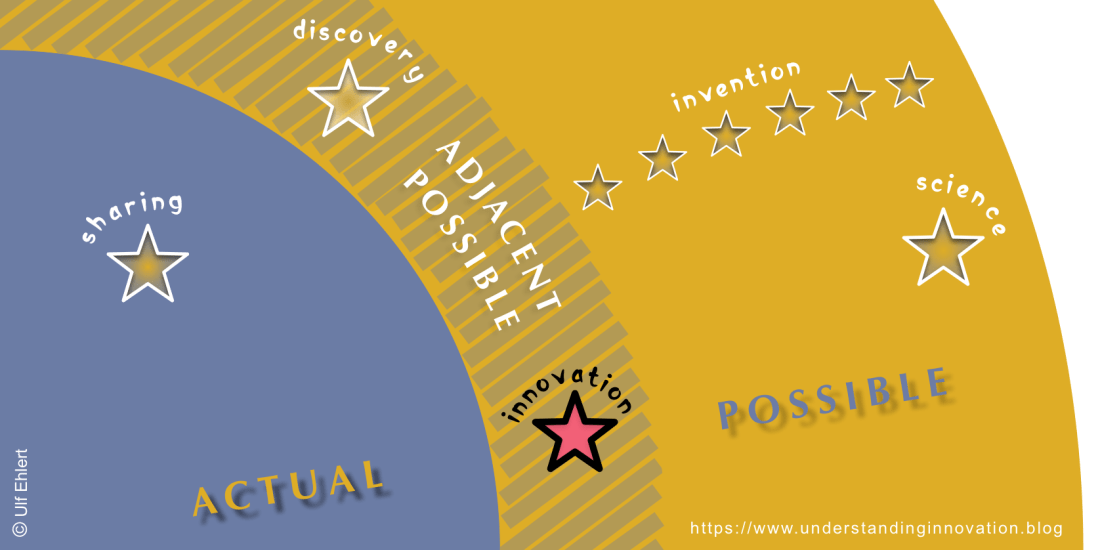
We have everything today that we need to shape tomorrow. All the ingredients for our future are available to us in the here and now. That is the very essence of progress: the future flows from the past, we shape it on the foundation of the past. We "only" need to find out how we can best combine the available ingredients to get the next task done. That's what we call progress. And we can make progress in different ways ...
Framing policies on Artificial Intelligence
Artificial Intelligence (or AI) is hotly debated for all the promise it holds and the concerns it raises. Opinions abound, and they range widely. From hailing AI as the harbinger of an entirely new level of human development, to cursing AI as ushering in the end of all human civilisation. Today, I'll highlight three recent contributions to the AI discussion that remind us of the wide-open option space we have for policies that can shape the AI we want to have in the future.
Trends to consider in policy-making – What to pursue
The emergence of the platform economy has created powerful non-state actors that have far-reaching influence on communities around the globe. In this new nexus of business, technology, and society, we need to rethink policy-making to blend innovation policy with foreign policy from the start. In contrast to the previous post, here I'll focus on four promising ideas we could pursue further.
Trends to consider in policy-making – What to avoid
The emergence of the platform economy has created powerful non-state actors that have far-reaching influence on communities around the globe. In this new nexus of business, technology, and society, we need to rethink policy-making to blend innovation policy with foreign policy from the start. Today, I’ll offer some thoughts about ongoing developments and look for outcomes we should try to avoid.
 understanding innovation