Who bears the risk of innovation failure?
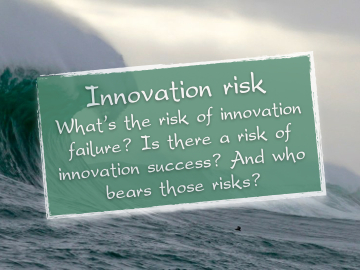
Innovation is all about novelty, about charting new territory and sailing unknown waters. This implies that the outcome of any innovative endeavour is by no means certain, let alone predetermined. On the contrary, innovation clearly entails risk, and in fact two different types of risk: one is for the innovator, the other for the society he's working in. With only mild exaggeration, you might consider the first the risk of innovation failure, whereas the other is the risk of innovation success.

Dealing with uncertainty

The Three Horizons present a powerful concept that helps us think about the future, that gives structure to our vision and ideas, our plans and concerns. This concept derives its strength from acknowledge the emergent character of the future, introducing three time horizons that coexist at any point in time, though in an evolving pattern.

Pushing the boundaries – Epilogue

Over the past few weeks I've visited the four quadrants of the innovation landscape (the short series of posts started here) to get a better idea of the boundaries between the quadrants and how they are pushed. Now it's time to zoom out again to take a look at the landscape as a whole, with two questions to consider: Is the landscape as symmetric as it seems? And how fast do the boundaries move?

The bounds of the wicked quadrant …

The wicked quadrant of the innovation landscape is characterised by deep uncertainty: nothing is known, nothing is established, neither rules nor tools are defined or available. That makes this fourth quadrant the antithesis of the certainty that shapes business as usual; but what does that mean for innovation in the fourth quadrant? Let's step a little closer.

Why business as usual stays within the boundaries …

The boundaries in the innovation landscape separate the known from the unknown, they divide the landscape into quadrants of different levels of certainty. Unlike the research quadrant and the disruptive quadrant, the first quadrant (business as usual) is framed by known problems and known ideas. With rules and tools defined and available, this is the realm of comforting certainty, of predictable circumstances.