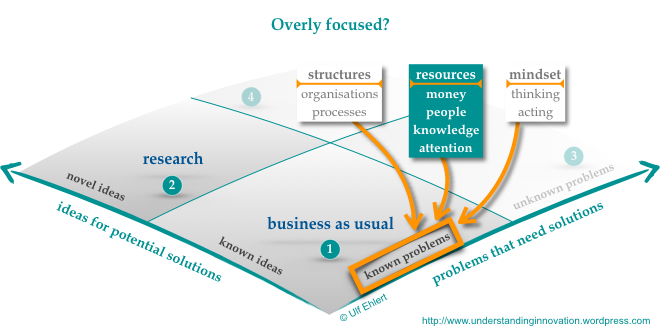
Tremendous resources – well balanced?

We commit tremendous resources to innovation, no doubt. Just look at the sheer size of the Research & Development departments of the big players across many industry sectors, and consider the multi-billion budgets they invest. For example, consider Samsung's R&D budget for 2016 (around 13 billion US$) and compare with the Gross Domestic Product (GDP) achieved around … Continue reading Tremendous resources – well balanced?

How our innovation structures deceive us

It's no surprise: for problems that have been around for a while, we usually develop certain structures to deal with them efficiently. Think about structures as organisations like companies or research laboratories, or processes like quality assurance or even the scientific method. Each of these established organisations and ready-made processes are designed for a purpose: to solve a specific known problem. And that's what … Continue reading How our innovation structures deceive us

What’s wrong with focusing on known problems?

At first glance, there shouldn't be anything wrong if a society focused its innovation effort on solving its known problems. However, if that focus becomes an obsession, this society will –over time– become increasingly vulnerable to the challenges presented by previously unknown problems. I believe that our structures, our resources, and even our mindset are so committed … Continue reading What’s wrong with focusing on known problems?

When energy flow broke free …

From an energy perspective, you might split the entire history of mankind in just two phases: one before, and the other after the Industrial Revolution. Before that incisive event, an archaic pattern of energy flow ruled: muscle was the main source of energy to fulfil human needs; this source was decentralised and easily available to everybody, but … Continue reading When energy flow broke free …

And what about the risk of innovation success?

The outcome of any innovative endeavour is by no means certain. Rather, innovation entails risk for the innovator as well as for the society he's working in. The first might be considered the risk of innovation failure, which I have already addressed in a previous post. The second risk is the risk of innovation success, and that's what I'll focus today's post on.