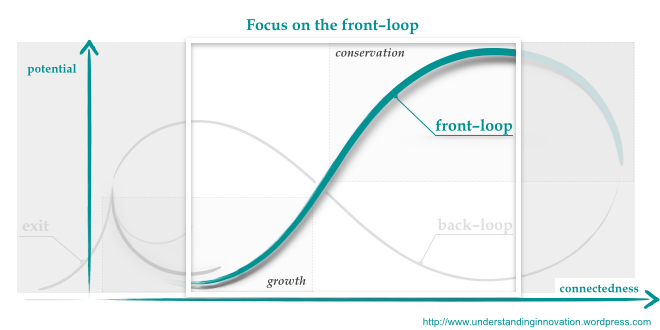
The depiction of the adaptive cycle as the lying eight has many compelling arguments in its favour. And still it is far from intuitive. While the pessimists have an inclination to look for the downsides in life, and thus can more easily reconcile their view of the world with the existence of the adaptive cycle with … Continue reading The downsides of a front–loop focus
Tag: disruption
Adaptive cycles and innovation – first contact
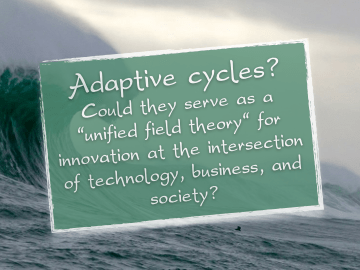
What is it that adaptive cycles could tell us about innovation? Which new perspective could they give us? Could they actually serve as a common backdrop, a "unifying field theory" that covers all dimensions of innovation? That could incorporate the relevant aspects of technology, business, and society? I'm curious to learn more about the ups and … Continue reading Adaptive cycles and innovation – first contact
How decentralisation enhances our innovation capacity
A few months ago, I started to take a deeper look into resource flows and how their patterns evolved over time. What the emerging flow patterns for information, energy, and material all have in common is the strong trend towards the decentralisation of distribution networks, which over time led to a genuine democratisation of access. As a result, today everybody can … Continue reading How decentralisation enhances our innovation capacity
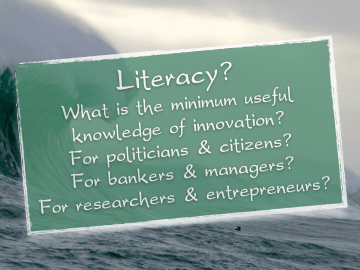
On literacy
Previously, I’ve discussed some flaws in the way that we teach science, and the particular implications for scientists themselves. However, the view(s) that non-scientists hold of science influence the success or failure of science in a multitude of ways, even though they are not active practitioners. How then does basic science education shape the views of the non-scientists?
The subtle flaws of science education
In his landmark book "The Structure of Scientific Revolutions" Thomas Kuhn describes how the majority of scientific work is actually focused on solving scientific puzzles. That’s what Kuhn calls normal science, and scientists are perfectly trained for and highly efficient in pursuing this endeavour. However, there are times when normal science reaches its limits and scientific revolutions arise, even though invisible to most scientists. Let’s take a look at the reasons for this blind spot and what its wider impact is.