
The work of Geoffrey West and his team is truly fascinating. In their cross-disciplinary research on complex adaptive systems, they looked for common underlying principles that could be applicable to biological systems and social systems alike. Of course I'm particularly interested in West's observations on social systems like cities and companies; and the different roles they play in innovation. Today, … Continue reading Cities, companies, and innovation – An emerging narrative
Tag: competition
Some second thoughts on first contact
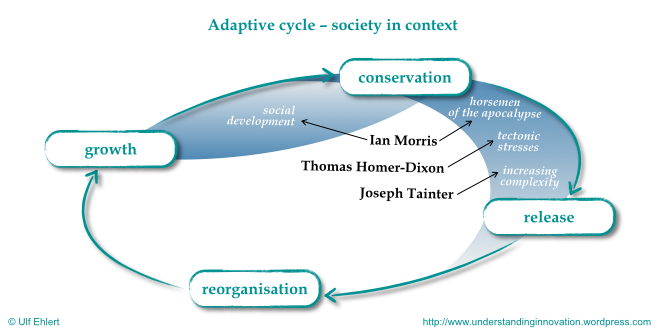
The concept of adaptive cycles can serve as a framework for a rich discussion on innovation. However, before diving deeper into the specifics of the concept, let's look at the basic description of the adaptive cycles again and review some of the earlier posts on this blog: to what extent do those ideas fit with this concept? I'd … Continue reading Some second thoughts on first contact
How information flow empowers innovation – Part 2
With the advent of movable type printing and wide-spread literacy in the 16th century, society departed from its traditional person-to-person mode of information exchange and entered into a new era: since those days, ideas can travel independent of a human carrier. What did we do with this new freedom; how did the patterns of information exchange evolve … Continue reading How information flow empowers innovation – Part 2
Dealing with uncertainty
The Three Horizons present a powerful concept that helps us think about the future, that gives structure to our vision and ideas, our plans and concerns. This concept derives its strength from acknowledge the emergent character of the future, introducing three time horizons that coexist at any point in time, though in an evolving pattern.
Why innovation policy fails …
Often times, the theory is one thing, and its application is something entirely different. Innovation policy is no exception, so that the transfer of conceptual ideas into practice is fraught with unpleasant surprise. I'd suggest two specific challenges to successful policy making in support of innovation: one is related to integrity, the other to competition.
 understanding innovation