
There are two distinct boundaries in the innovation landscape. One boundary separates the known ideas from novel ideas. The other boundary divides the landscape into the areas of known problems on one side and unknown or unacknowledged problems on the other. Both are boundaries between the unknown and the unknown, hence these boundaries will be pushed forward everytime of novel idea is developed or a new problem is encountered.
Tag: business
Rules and tools
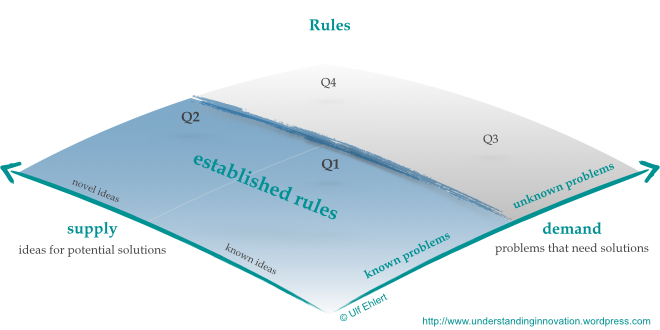
So far I've charted the innovation landscape along two axes: the demand for problem solutions and the supply of ideas for potential solutions. Today, I'll explore this concept further, focusing on rules and tools: to what extent do we have rules in place and tools available to facilitate and promote the innovation we need?
Charting the innovation landscape
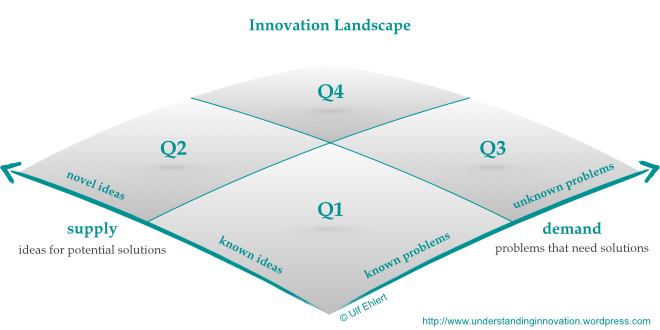
In the spirit of "A picture says more than a thousand words", I feel the need to come up with a graphical depiction of the innovation landscape; to recap some of the earlier ideas, to develop them further, and to cover new ground. Let's have a look.
On international collaboration

Globalisation is the evolving background and increasingly becomes the driving factor for many of our considerations and actions; and science, technology, and innovation are no exceptions to this trend. Today, I'll focus on how globalisation provides entirely new means and opportunities to solve problems. How does globalisation help us so that 1 + 1 > 2 ? That's neither black magic nor strange mathematics ...
Funding innovation – a broken cycle?

Without a doubt, Clayton Christensen is one of the most prolific thinkers, scholars, and writers on innovation. He is probably best known for having coined the term “disruptive innovation”, but that is only the tip of the iceberg. He developed a theory of economic growth that builds on three types of innovation: disruptive, sustaining, and efficiency innovations. Let’s see.
 understanding innovation