
Over the past few weeks I've visited the four quadrants of the innovation landscape (the short series of posts started here) to get a better idea of the boundaries between the quadrants and how they are pushed. Now it's time to zoom out again to take a look at the landscape as a whole, with two questions to consider: Is the landscape as symmetric as it seems? And how fast do the boundaries move?
Category: society & politics
The bounds of the wicked quadrant …

The wicked quadrant of the innovation landscape is characterised by deep uncertainty: nothing is known, nothing is established, neither rules nor tools are defined or available. That makes this fourth quadrant the antithesis of the certainty that shapes business as usual; but what does that mean for innovation in the fourth quadrant? Let's step a little closer.
How disruption pushes the boundary …
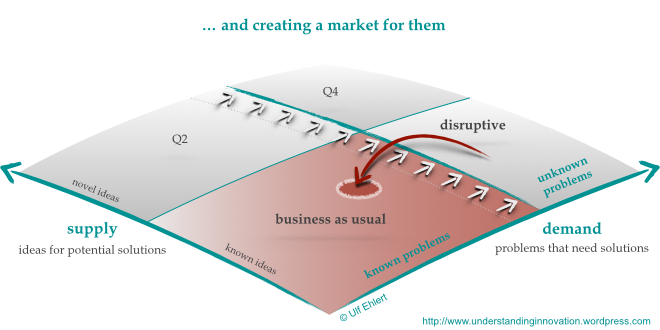
The innovation landscape I have sketched previously suggests that there could be some kind of symmetry. The third quadrant (disruptive) should have some similarity with the second quadrant (research), shouldn't it?
Pushing the boundaries – Prologue
There are two distinct boundaries in the innovation landscape. One boundary separates the known ideas from novel ideas. The other boundary divides the landscape into the areas of known problems on one side and unknown or unacknowledged problems on the other. Both are boundaries between the unknown and the unknown, hence these boundaries will be pushed forward everytime of novel idea is developed or a new problem is encountered.
Rules and tools
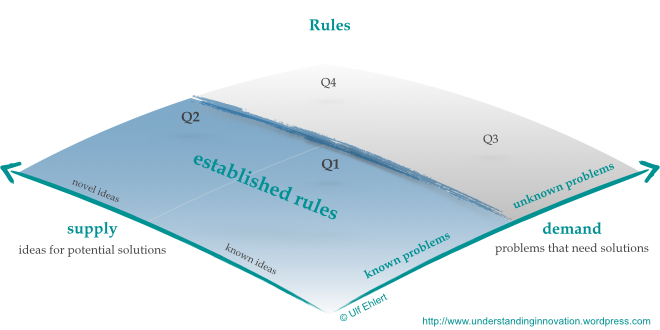
So far I've charted the innovation landscape along two axes: the demand for problem solutions and the supply of ideas for potential solutions. Today, I'll explore this concept further, focusing on rules and tools: to what extent do we have rules in place and tools available to facilitate and promote the innovation we need?
 understanding innovation