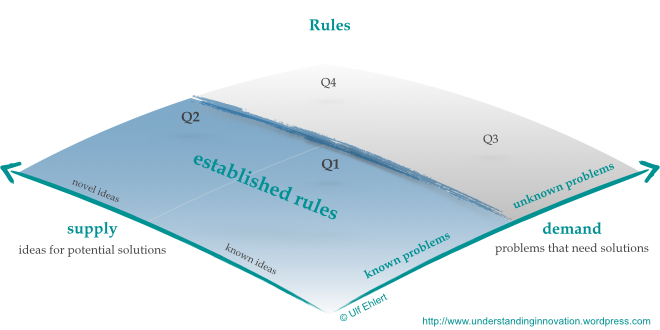
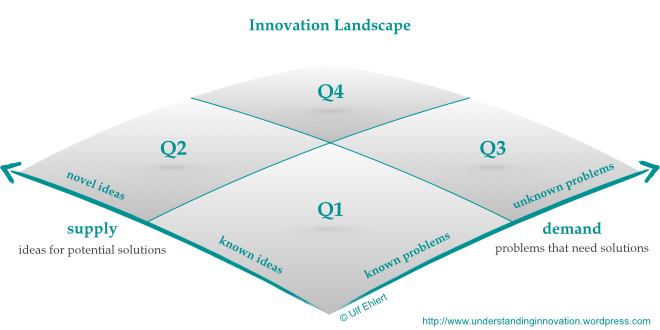
So far I've charted the innovation landscape along two axes: the demand for problem solutions and the supply of ideas for potential solutions. Today, I'll explore this concept further, focusing on rules and tools: to what extent do we have rules in place and tools available to facilitate and promote the innovation we need?
Category: innovation
Charting the innovation landscape
In the spirit of "A picture says more than a thousand words", I feel the need to come up with a graphical depiction of the innovation landscape; to recap some of the earlier ideas, to develop them further, and to cover new ground. Let's have a look.
On international collaboration
Globalisation is the evolving background and increasingly becomes the driving factor for many of our considerations and actions; and science, technology, and innovation are no exceptions to this trend. Today, I'll focus on how globalisation provides entirely new means and opportunities to solve problems. How does globalisation help us so that 1 + 1 > 2 ? That's neither black magic nor strange mathematics ...
Integrating citizen science
The concept has many names: networked science, crowd-sourced science, crowd science, civic science, or citizen science. All these terms emphasise a specific aspect, and all those aspects play a more or less important role in the overall concept. Let's see.
Attention! Attention!
"Expert attention is to creative problem solving what water is to life in the desert: it is the fundamental scarce resource." That is Michael Nielsen's main thesis in 'Reinventing Discovery', which is really a book about the future of science.