A vision for economics

What could our economy and society be like in thirty to forty, maybe even fifty years? Just doing the same things differently? Or doing really different things? What could those things be? And what could economics tell us about that far-term future? If you ask for such genuine vision, the reaction you'll most likely receive ranges somewhere between an innocent shrug and a linear extrapolation of the recent past: neither inspired nor very inspiring. With only few exceptions.

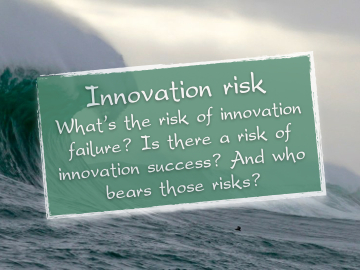
And what about the risk of innovation success?

The outcome of any innovative endeavour is by no means certain. Rather, innovation entails risk for the innovator as well as for the society he's working in. The first might be considered the risk of innovation failure, which I have already addressed in a previous post. The second risk is the risk of innovation success, and that's what I'll focus today's post on.

Who bears the risk of innovation failure?

Innovation is all about novelty, about charting new territory and sailing unknown waters. This implies that the outcome of any innovative endeavour is by no means certain, let alone predetermined. On the contrary, innovation clearly entails risk, and in fact two different types of risk: one is for the innovator, the other for the society he's working in. With only mild exaggeration, you might consider the first the risk of innovation failure, whereas the other is the risk of innovation success.

Dealing with uncertainty

The Three Horizons present a powerful concept that helps us think about the future, that gives structure to our vision and ideas, our plans and concerns. This concept derives its strength from acknowledge the emergent character of the future, introducing three time horizons that coexist at any point in time, though in an evolving pattern.

It’s about time …

Time turns out to be a difficult subject to handle, especially when we are trying to make sense of what is lying ahead, when we are talking and thinking about the future. We often feel a sense of puzzle and confusion, an uncomfortable element of surprise. In Alvin Toffler's famous words: "The future always comes too fast and in the wrong order."