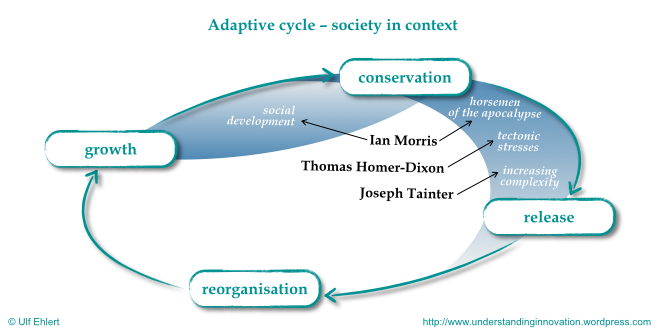
The concept of adaptive cycles can serve as a framework for a rich discussion on innovation. However, before diving deeper into the specifics of the concept, let's look at the basic description of the adaptive cycles again and review some of the earlier posts on this blog: to what extent do those ideas fit with this concept? I'd … Continue reading Some second thoughts on first contact
Category: innovation
Adaptive cycles and innovation – first contact
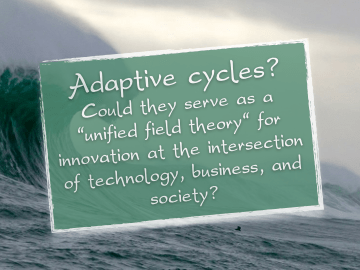
What is it that adaptive cycles could tell us about innovation? Which new perspective could they give us? Could they actually serve as a common backdrop, a "unifying field theory" that covers all dimensions of innovation? That could incorporate the relevant aspects of technology, business, and society? I'm curious to learn more about the ups and … Continue reading Adaptive cycles and innovation – first contact
The dynamic ups and downs of human systems
No matter how hard we try to keep things simple and under control, many man-made systems turn out to be – or to become over time – quite complex and unpredictable. Despite our effort. Against our intentions. In stark contrast to our preference for simple, linear, static, controllable, predictable systems. Computer software, stock markets and tax codes are … Continue reading The dynamic ups and downs of human systems
No future for employment?
Every now and then you come across a truly eye-opening piece of writing that you just need to share with as many people as you possibly can. For me, such revelation came with Derek Thompson's A World without Work, published in the July/August issue of The Atlantic. So don't be surprised that this post is shamelessly advertising Thompson's thorough … Continue reading No future for employment?
The Dunning-Kruger effect in innovation
One way or another, I'm sure you are all familiar with the Dunning-Kruger effect. You might have heard about it under the label of confident idiots, describing a behaviour of an unskilled individual being unaware of the lack of a specific skill, instead assuming to have a skill-level that is even superior to the experts in the field. … Continue reading The Dunning-Kruger effect in innovation